




























The Critical Role of Rubber Expansion Joints in Defense & Heavy-Duty Equipment
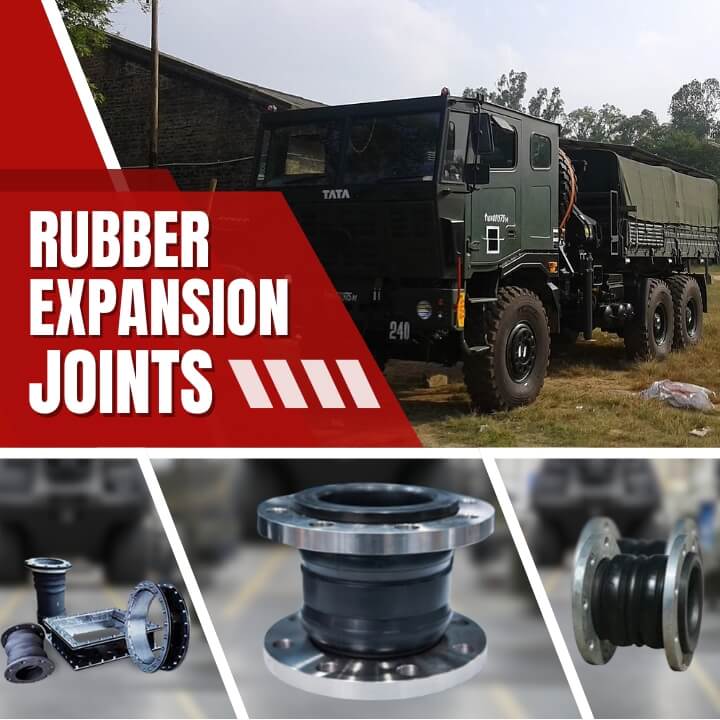
Defense systems and heavy equipment operate under vibration, shock, temperature variation and demanding environmental conditions. Piping connected to engines, pumps, compressors, cooling circuits and auxiliary equipment must accommodate movement without transferring excessive loads to adjoining components. Rubber expansion joints for defense equipment provide a flexible connection that can absorb specified movement, isolate vibration and compensate for limited installation misalignment when correctly engineered and installed.
AB Elasto Products Pvt. Ltd. manufactures industrial rubber and polymer products, including custom rubber expansion joints for critical applications. Selection should be based on the actual operating media, pressure, temperature, movement and connection requirements rather than nominal pipe size alone.
Why Rubber Expansion Joints Are Used
A rubber expansion joint is a flexible connector installed in piping or ducting. Depending on its design, it can accommodate axial compression or extension, lateral displacement and angular movement. Its elastomeric construction can also reduce the transmission of mechanical vibration and structure-borne noise.
- Movement compensation: Helps manage defined thermal growth, equipment movement and operational displacement.
- Vibration isolation: Reduces vibration transmitted by pumps, engines, compressors and other equipment.
- Piping stress reduction: Provides flexibility where a rigid connection could transfer loads to equipment nozzles, supports or pipework.
- Limited misalignment compensation: Accommodates specified installation offsets but should not be used to correct major piping errors.
- Fluid containment: Uses a media-compatible inner tube and suitable reinforcement for the specified pressure or vacuum.
Expansion joints do not replace correctly designed anchors, guides and supports. Pressure thrust and combined movements must be considered as part of the complete piping system.
Defense and Heavy-Equipment Applications
Application requirements differ between platforms, but engineered rubber expansion joints may be used in compatible piping and ducting associated with:
- Military and specialist vehicles: Cooling, ventilation and auxiliary-fluid connections exposed to engine vibration and chassis movement.
- Naval and marine systems: Pump connections, seawater services, ventilation ducting and auxiliary piping.
- Construction and mining equipment: Connections near engines, compressors and processing equipment subjected to continuous vibration, dust and outdoor exposure.
- Power and utility equipment: Water, air and compatible process services requiring controlled flexibility.
- Test and ground-support systems: Purpose-designed connections for specified pressure, temperature, media and movement conditions.
Suitability for fuel, hydraulic fluid, exhaust gas or hazardous media must be confirmed for the exact elastomer compound, reinforcement and operating envelope. A standard rubber joint should never be assumed suitable for every defense application.
Material and Construction Selection
A typical rubber expansion joint contains a media-contact inner tube, textile or fabric reinforcement, an external protective cover and a flange arrangement. Additional reinforcement may be required where the design involves higher pressure or vacuum. The arch profile, number of arches and face-to-face length influence movement capability, stability and spring rate.
Common elastomers include:
- EPDM: Often considered for water, hot-water, weathering and ozone-resistant applications. It is generally unsuitable for petroleum oils and hydrocarbon fuels.
- NBR: Commonly selected for compatible petroleum-based oils, fuels and hydraulic fluids.
- CR (neoprene): Offers a balance of weather, ozone, moderate oil and mechanical resistance for selected industrial services.
- Natural rubber: Provides resilience, abrasion resistance and vibration-damping properties for compatible media and temperatures.
- Specialized compounds: Silicone, FKM or other formulations may be evaluated for particular temperature or chemical conditions.
These descriptions are preliminary guidance only. Final selection must consider chemical concentration, exposure duration, continuous and peak temperatures, external environment and the approved compound specification.
Engineering Data Required
Accurate operating information allows the manufacturer to evaluate the joint geometry, elastomer, reinforcement and flange configuration. Provide:
- Nominal pipe size, face-to-face length and flange or connection details
- Operating, design and test pressure, including vacuum where applicable
- Normal, minimum and maximum temperatures
- Conveyed media, concentration and cleaning chemicals
- Required axial, lateral and angular movements, including combined movement
- External exposure, duty cycle and applicable inspection or documentation requirements
Control units, protective covers or an alternative joint design may be required depending on pressure thrust, system arrangement and external hazards.
Testing and Quality Assurance
The inspection and test plan should be agreed before manufacturing. Depending on the customer specification, verification may include dimensional inspection, visual examination, material-property checks, hardness testing, pressure or vacuum testing and documentation traceability. Movement or fatigue validation may also be required for critical cyclic applications.
AB Elasto operates under an ISO 9001:2015 quality management system. ISO 9001 supports controlled manufacturing and quality processes; it should not be presented as a product-performance or military certification. Any product-standard, defense-specification or acceptance requirement must be defined in the purchase specification and verified for the supplied product.
Installation and Inspection
- Confirm that piping anchors, guides and supports match the approved system design.
- Do not exceed the specified installation length or movement rating.
- Align mating flanges and tighten fasteners evenly using the approved sequence.
- Protect the rubber surface from sharp tools, welding spatter and unsuitable gasket materials.
- Inspect periodically for cracking, blistering, abrasion, leakage, deformation or loose hardware.
Why Application-Specific Engineering Matters
Defense and heavy-equipment systems can combine vibration, restricted installation space, pressure fluctuations and changing environmental conditions. Reliable performance therefore depends on the complete design: joint geometry, elastomer compatibility, reinforcement, flange configuration, piping supports and installation controls must work together.
AB Elasto supports custom industrial rubber-product development for demanding applications. Share the media, pressure, temperature, movement, dimensions and applicable technical requirements with our team so that an appropriate construction can be evaluated.
Conclusion
Properly engineered rubber expansion joints can help manage vibration, movement and piping loads in defense and heavy equipment. Performance depends on accurate operating data, compatible materials, suitable reinforcement, correct system supports and controlled installation.
Need a custom rubber expansion joint? Explore the AB Elasto product range or contact our technical team with your operating and dimensional requirements.

With 30+ years of expertise, AB Elasto is an ISO-certified Industrial Rubber Products Manufacturer in India, delivering industrial rubber hoses, railway rubber components, rubber expansion joints, and OEM rubber solutions.
- ISO: 9001:2015 Certified
- Advanced Manufacturing
- OEM Rubber Solutions
What Our Clients Say

Agni Mazumder
Dear AB Elasto team,Thank you for your continuous support to us. Please continue supporting us.
Category Head: Electrical, Rubber, Hose & Pipes. Supply Chain Managment Tata Hitachi Construction Machinery Co. Pvt. Ltd.

Andrew Jayaprakash
I can rely on AB Elasto Products Pvt Ltd for quick development of moulded hoses with good quality at a reasonable price. All queries are answered promptly, in a timely manner that makes it easier to work with AB Elasto