

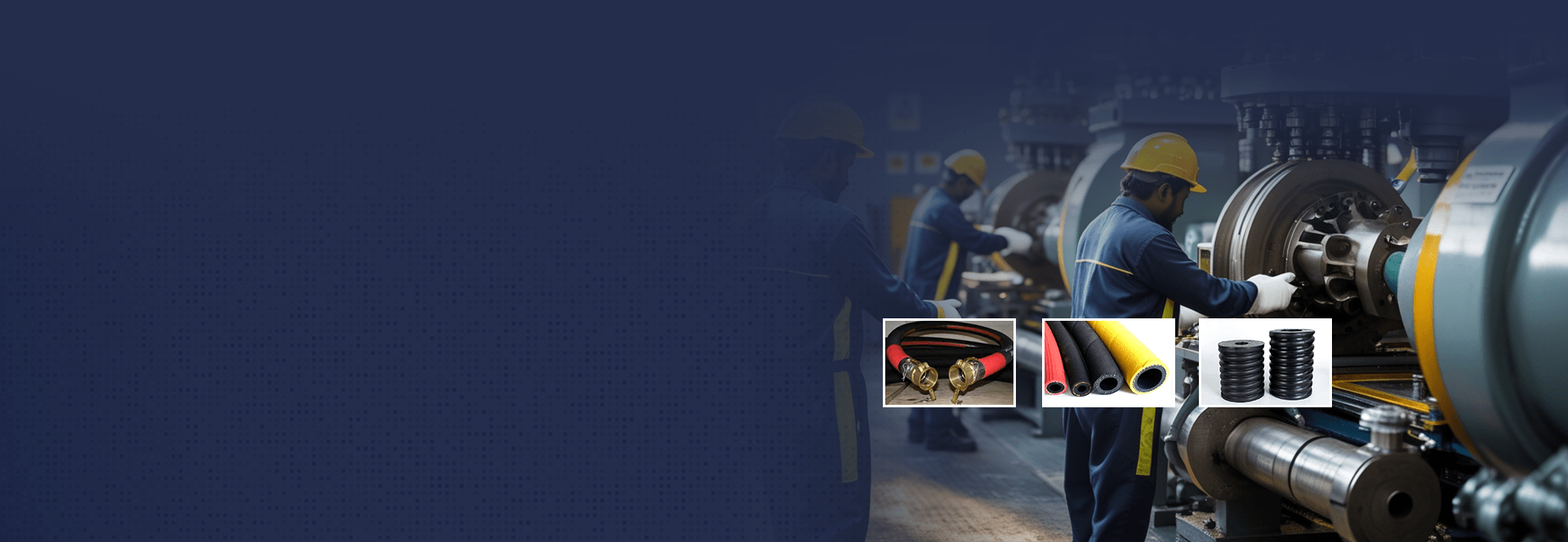



























The Future of Industrial Rubber: Key Trends Driving Market Growth in 2025 & Beyond
Industrial rubber products support fluid transfer, vibration control, sealing, movement compensation and impact protection across railways, power plants, petrochemicals, automotive systems, mining, construction equipment, marine applications and heavy machinery. As operating requirements become more specific, manufacturers are moving away from generic components toward application-matched materials, reinforced constructions, controlled testing and better technical documentation.
These industrial rubber trends are influencing the development of hoses, railway components, expansion joints, mountings and moulded rubber parts. AB Elasto Products Pvt. Ltd. supports this shift through its industrial rubber and polymer product range and custom-development capabilities.
1. Application-Specific Elastomer Selection
Industrial buyers increasingly expect material selection to be supported by operating data. Choosing rubber only by polymer name can overlook differences in compound formulation, temperature capability, chemical compatibility, hardness, aging resistance and mechanical properties.
- NBR: Commonly evaluated for compatible petroleum oils, fuels and hydraulic fluids
- EPDM: Often considered for water, weathering, ozone and selected temperature-resistant applications
- CR: Can provide balanced weather, abrasion and moderate oil resistance
- Natural rubber: Offers resilience, abrasion resistance and vibration-damping properties for compatible services
- Specialized compounds: May be required for aggressive chemicals, higher temperatures or demanding environmental exposure
The future of material selection is therefore specification-led. Media concentration, pressure, temperature, movement, exposure duration and external environment should be reviewed before approving a compound.
2. Reinforced Products for Demanding Service
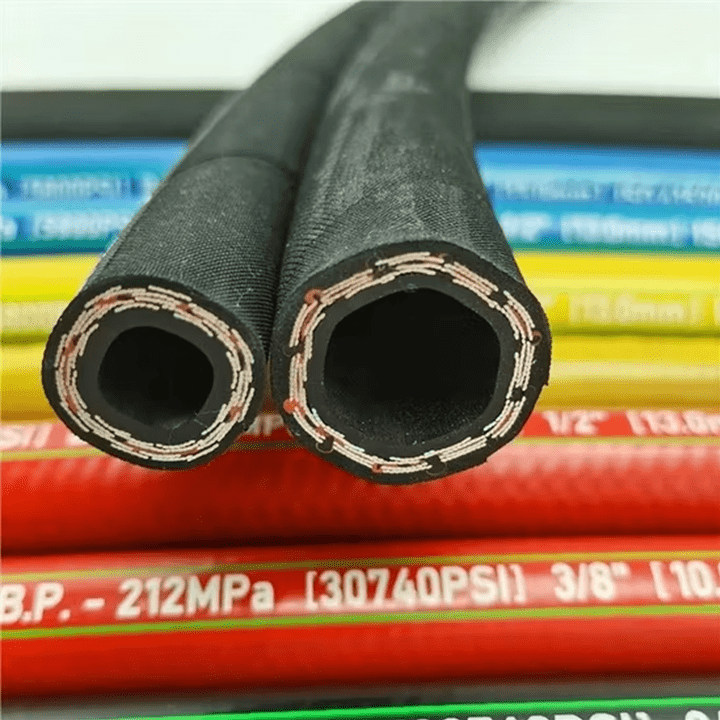
Reinforcement allows rubber products to combine flexibility with pressure or load capability. In industrial hoses, textile braid, wire braid and spiral-wire layers control pressure expansion and impulse behaviour. In rubber expansion joints, textile or fabric plies support pressure integrity while allowing specified axial, lateral or angular movement.
More reinforcement is not automatically better. Layer material, angle, adhesion, geometry and interaction with the rubber compound determine finished-product performance. OEMs increasingly require the complete construction to be evaluated against pressure cycles, bend radius, movement and installation constraints.
3. Growth of Custom and Import-Substitution Engineering
Machinery manufacturers often need replacement or newly developed components that are not available as standard catalogue items. This is increasing demand for custom moulded rubber parts, hoses, mountings, bellows, bushes, pads and protective components manufactured to approved drawings.
Successful custom development requires more than reproducing dimensions. The supplier must understand:
- Component function and failure risks
- Static, dynamic and impact loads
- Media and environmental exposure
- Hardness, deflection and movement requirements
- Tolerances and mating interfaces
- Inspection, testing and traceability needs
AB Elasto operates under the BHOLTECH brand and supports application-specific industrial rubber development for OEM and critical industrial requirements.
4. Greater Focus on Vibration and Noise Control
Higher equipment speeds, operator-comfort expectations and machinery-protection requirements are increasing attention on vibration isolation. Industrial mountings, resilient pads, bump stops and flexible connectors can help reduce transmitted vibration and shock when correctly selected.
Mounting design should consider supported mass, load direction, disturbing frequency, required deflection and available movement. Selecting only by hardness or physical dimensions can produce an incorrect stiffness and reduce isolation effectiveness.
5. Digital Quality Records and Traceability
Manufacturing is moving toward more structured product data, process monitoring and supply-chain traceability. For industrial rubber products, practical improvements can include controlled drawings, batch identification, material records, inspection results, calibrated test equipment and documented revision control.
Automated inspection and data analysis may assist manufacturing quality, but they do not create defect-free products by themselves. Measurement methods, acceptance criteria, trained personnel and process controls remain essential. Digital tools should strengthen—not replace—sound engineering and quality practices.
6. Durability and Lifecycle-Based Selection
OEMs and plant operators increasingly evaluate total service value rather than initial purchase cost alone. A product that is correctly matched to the media, pressure, temperature and movement can reduce premature replacement, leakage and unplanned maintenance.
Lifecycle performance also depends on correct installation and inspection. Hose routing, bend radius, compatible fittings, piping anchors, flange alignment and protection from abrasion or heat can be as important as the rubber compound itself.
7. Sustainability and Material Efficiency
Resource efficiency, waste reduction and circularity are becoming more important across manufacturing supply chains. For industrial rubber products, realistic sustainability measures can include:
- Reducing production scrap through better process control
- Improving product life through correct material and application selection
- Using manufacturing data to reduce rejection and rework
- Evaluating recycled or bio-based content where technical performance and safety can be validated
- Improving material and product information across the supply chain
Recycled or bio-based material should not be described as automatically sustainable or suitable for critical service. Performance, durability, traceability and end-of-life options must be assessed together.
Industry Applications Driving Product Development
Railways and Public Transport
Railway applications require specification-controlled air brake hoses, resilient components, bump stops, mountings and moulded parts for braking, suspension, vibration control and impact protection.
Automotive, Construction and Mining Equipment
These sectors use reinforced hoses, engine mountings, bushes, seals and moulded components exposed to vibration, oils, dust, abrasion and repeated mechanical loads.
Power, Petrochemical and Process Industries
Industrial hoses and rubber expansion joints support fluid transfer, piping flexibility and vibration isolation. Material compatibility, temperature, pressure and chemical concentration are central selection inputs.
Marine and Defense Applications
Application-specific hoses, expansion joints and moulded components may require resistance to saltwater, weathering, oils, vibration and restricted installation conditions. Exact platform specifications and documentation requirements must be confirmed.
AB Elasto Product Development Approach
AB Elasto’s product range includes industrial rubber hoses, railway products, rubber expansion joints, industrial mountings, moulded rubber items and selected plastic components. Development can be based on customer drawings, operating data, samples and agreed inspection requirements.
ISO 9001:2015 supports AB Elasto’s quality management system. Product compliance should be stated only against the exact standard, drawing, revision and verified scope applicable to the supplied component.
Conclusion
The future of industrial rubber is being shaped by application-specific materials, reinforced constructions, custom engineering, vibration control, traceability, durability and responsible resource use. These trends place greater importance on accurate operating data and collaboration between the OEM, user and rubber-product manufacturer.
Planning a new or replacement industrial rubber component? Explore the AB Elasto product range or contact our technical team with your drawing, media, pressure, temperature, movement and quantity requirements.

With 30+ years of expertise, AB Elasto is an ISO-certified Industrial Rubber Products Manufacturer in India, delivering industrial rubber hoses, railway rubber components, rubber expansion joints, and OEM rubber solutions.
- ISO: 9001:2015 Certified
- Advanced Manufacturing
- OEM Rubber Solutions
What Our Clients Say

Agni Mazumder
Dear AB Elasto team,Thank you for your continuous support to us. Please continue supporting us.
Category Head: Electrical, Rubber, Hose & Pipes. Supply Chain Managment Tata Hitachi Construction Machinery Co. Pvt. Ltd.

Andrew Jayaprakash
I can rely on AB Elasto Products Pvt Ltd for quick development of moulded hoses with good quality at a reasonable price. All queries are answered promptly, in a timely manner that makes it easier to work with AB Elasto