

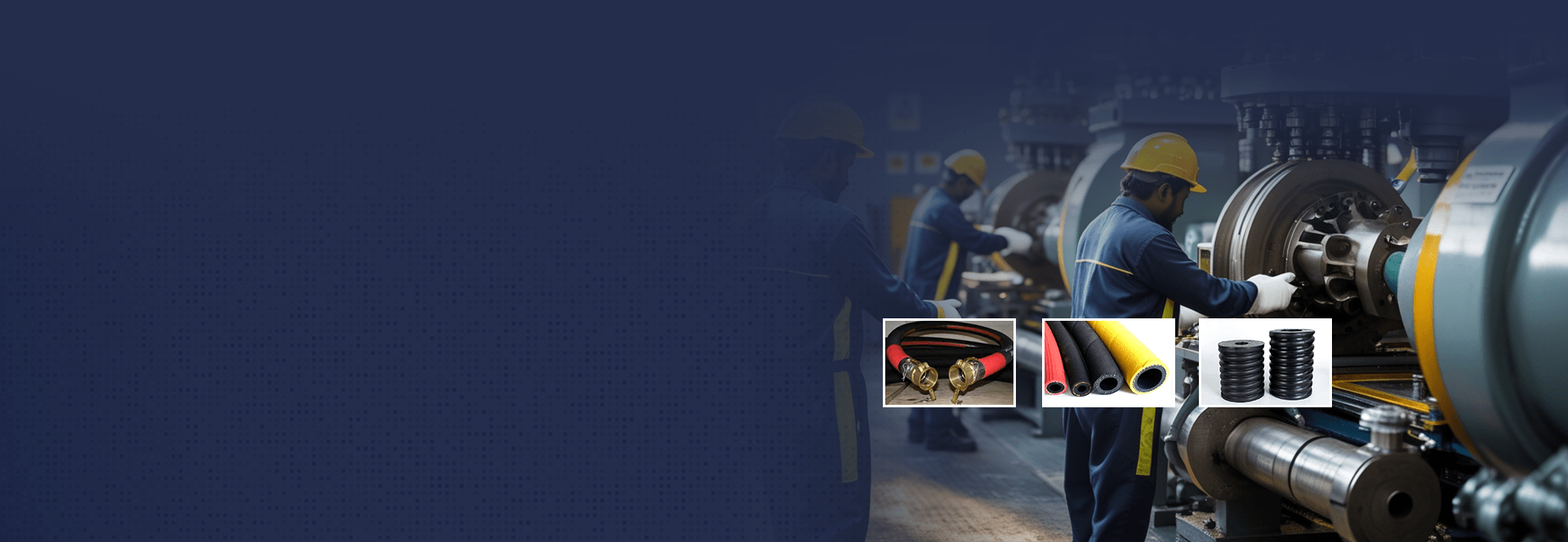



























Why OEMs Are Prioritizing High-Performance Rubber Components in Industrial Machinery
Original Equipment Manufacturers need components that integrate reliably with machinery, meet drawing requirements and perform consistently throughout the intended service life. In railways, construction equipment, automotive systems, power plants, mining and process industries, OEM rubber components support vibration control, fluid transfer, sealing, movement compensation, impact protection and electrical or thermal isolation.
AB Elasto Products Pvt. Ltd. develops and manufactures industrial rubber and polymer products for standard and application-specific requirements. Its product range includes industrial rubber hoses, railway components, rubber expansion joints, industrial mountings, moulded rubber parts and selected plastic components.
Why OEM Applications Require Engineered Rubber Parts
Industrial machinery can combine vibration, pressure, temperature variation, chemicals, abrasion and repeated movement. A generic part selected only by shape or rubber type may not provide the required performance. OEM development should consider the complete application:
- Mechanical loads: Static load, shock, vibration, movement and fatigue cycles
- Operating environment: Temperature, weathering, ozone, moisture, dust and abrasion
- Media exposure: Oils, fuels, coolants, water, air, steam or process chemicals
- Dimensional requirements: Tolerances, interfaces, assembly space and mating components
- Validation needs: Inspection, testing, traceability and customer documentation
These inputs guide elastomer selection, reinforcement, hardness, geometry, manufacturing method and acceptance criteria.
Industrial Mountings for Vibration and Shock Control
Rubber mountings help isolate vibration between machinery and its supporting structure. Depending on the design, they can reduce transmitted vibration, limit structure-borne noise and protect connected equipment from shock loads.
OEM mounting development requires the supported mass, load direction, disturbing frequency, desired isolation and available movement. Rubber hardness and geometry affect stiffness and deflection; a harder compound is not automatically more durable or better at vibration isolation.
AB Elasto’s mounting range supports application-specific requirements for heavy machinery, construction equipment, generators, compressors and railway systems. Potential products include engine mountings, resilient pads, bump stops and elastic elements manufactured to approved drawings.
Industrial Rubber Hoses for Fluid and Air Transfer
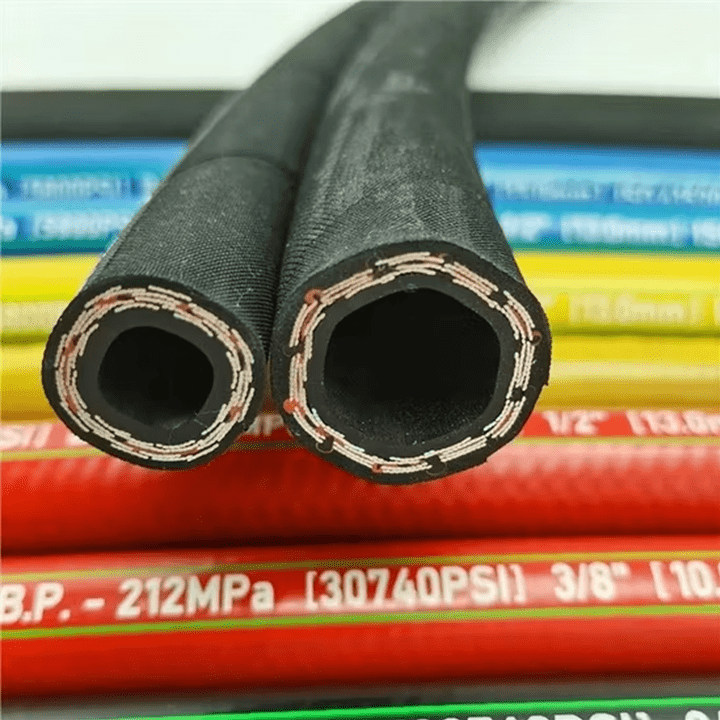
OEM hoses must transport compatible media while accommodating routing, movement and pressure. The inner tube provides media resistance, reinforcement controls pressure expansion and the cover protects against the external environment.
- Hydraulic and low-pressure hoses: Selected according to pressure, impulse, fluid compatibility, temperature and fittings
- Air and pneumatic hoses: Designed around pressure integrity, flexibility and external exposure
- Chemical and petroleum hoses: Require exact media, concentration and temperature data
- Steam, hot-air and coolant hoses: Need specification-defined temperature, pressure and aging performance
- Railway hoses: Manufactured to the applicable drawing, dimensions, coupling arrangement and inspection requirements
Read the AB Elasto guide to industrial hose reinforcement for a technical comparison of textile braid, wire braid and spiral constructions.
Rubber Expansion Joints for Piping Flexibility
Rubber expansion joints are flexible connectors used to accommodate specified axial, lateral or angular movement and isolate vibration in piping or ducting. OEM selection must account for media compatibility, pressure or vacuum, temperature, required movement, flange arrangement and system anchors.
A typical construction includes an elastomeric inner tube, textile or fabric reinforcement and a protective outer cover. Metallic reinforcement may be added where required by the approved design. Material choice must be based on the actual operating conditions rather than a generic temperature or chemical-resistance claim.
For more detail, see the guide to elastomer selection for rubber expansion joints.
Moulded Rubber Components
Custom moulded parts can provide sealing, cushioning, protection, movement control or structural support. Examples include bushes, pads, grommets, bellows, seals, buffers, boots and application-specific profiles.
Effective development begins with a controlled drawing and clear functional requirements. Important inputs include:
- Component dimensions, tolerances and critical interfaces
- Static and dynamic loads
- Required hardness, compression or deflection behaviour
- Media, temperature and environmental exposure
- Expected production volume and inspection level
The correct moulding process, tooling and compound should be selected together. Changing hardness or polymer without reviewing component geometry can affect fit and functional performance.
Railway and Polymer Components
AB Elasto’s railway range includes rubber products for braking, suspension, vibration control and impact protection, subject to the applicable railway drawing and specification. Product identification, dimensional control, material properties and traceability are particularly important for safety-related applications.
Selected plastic and polymer components, such as tubing, covers, caps and protective items, can complement rubber parts where lower weight, chemical resistance, insulation or dimensional stability is required. Material choice must reflect load, temperature, chemical exposure and assembly method.
From OEM Requirement to Production
A disciplined OEM-development process reduces ambiguity and improves production consistency:
- Application review: Define function, loads, media, environment and failure risks.
- Specification review: Confirm drawings, tolerances, materials, standards and documentation.
- Material and process selection: Choose the compound, reinforcement and manufacturing route.
- Sample development: Produce and inspect samples before production approval where required.
- Validation: Complete agreed dimensional, material and performance checks.
- Production control: Maintain approved specifications, inspection records and change control.
Testing should match the individual product and purchase specification. ISO 9001:2015 supports AB Elasto’s quality management processes; it does not automatically certify every component to all ISO, BIS, SAE, RDSO or other industry standards.
Choosing an OEM Rubber-Component Supplier
OEM buyers should evaluate technical understanding, manufacturing capability, material control, testing, documentation, responsiveness and supply consistency. The supplier should be able to explain how the proposed material and construction relate to the actual operating conditions.
AB Elasto has manufactured industrial rubber products since 1996 and supports custom development for railways, heavy equipment, automotive, power, petrochemical, mining and other industrial applications.
Conclusion
OEM rubber components influence machinery reliability through vibration control, fluid transfer, sealing, flexibility and protection. Successful development requires correct application data, compatible materials, controlled drawings, suitable manufacturing and specification-based validation.
Developing a new or replacement component? Explore the AB Elasto product range or contact our technical team with your drawing, operating conditions, quantity and inspection requirements.

With 30+ years of expertise, AB Elasto is an ISO-certified Industrial Rubber Products Manufacturer in India, delivering industrial rubber hoses, railway rubber components, rubber expansion joints, and OEM rubber solutions.
- ISO: 9001:2015 Certified
- Advanced Manufacturing
- OEM Rubber Solutions
What Our Clients Say

Agni Mazumder
Dear AB Elasto team,Thank you for your continuous support to us. Please continue supporting us.
Category Head: Electrical, Rubber, Hose & Pipes. Supply Chain Managment Tata Hitachi Construction Machinery Co. Pvt. Ltd.

Andrew Jayaprakash
I can rely on AB Elasto Products Pvt Ltd for quick development of moulded hoses with good quality at a reasonable price. All queries are answered promptly, in a timely manner that makes it easier to work with AB Elasto