



























Advanced Hose Engineering: How Reinforcement Layers Improve Pressure Tolerance and Flexibility
Industrial rubber hoses transfer air, water, oils, chemicals and other compatible media through mobile equipment and stationary systems. Their ability to contain pressure while remaining flexible depends on the complete construction: inner tube, reinforcement, outer cover and end fittings. Of these elements, industrial hose reinforcement plays a central role in controlling pressure expansion, movement, bend behaviour and resistance to repeated pressure cycles.
AB Elasto Products Pvt. Ltd. manufactures industrial rubber hoses for railway, automotive, petrochemical, mining, construction and OEM applications. Reinforcement must be selected according to the conveyed media, working pressure, pressure impulses, temperature, bend radius, external environment and applicable product specification.
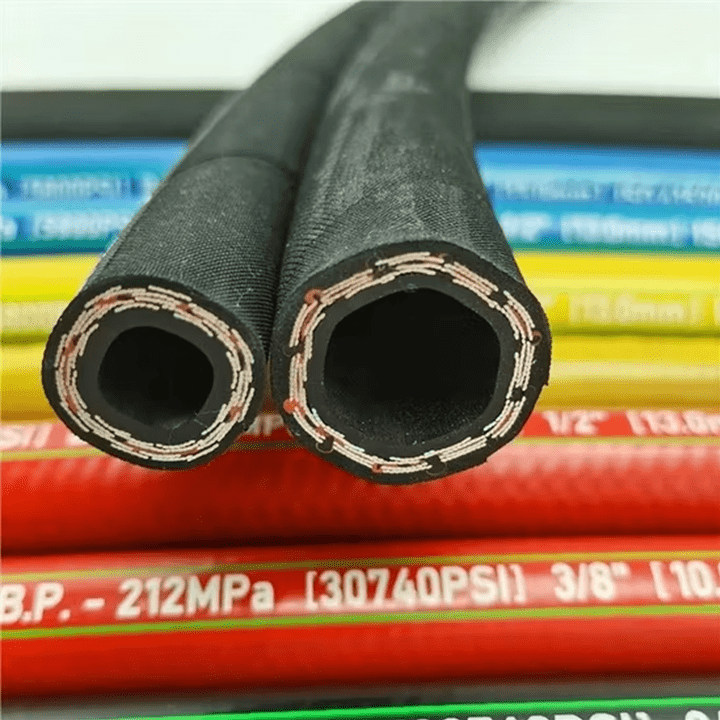
How a Reinforced Rubber Hose Is Constructed
A typical industrial hose contains three functional layers:
- Inner tube: Contacts the conveyed media and must resist chemical attack, temperature, permeation and pressure-related stress.
- Reinforcement: Carries internal pressure loads, controls dimensional change and supports the required bend and impulse performance.
- Outer cover: Protects the reinforcement from abrasion, ozone, weathering, oil splash, heat and other external exposure.
The maximum working pressure of the finished assembly must not exceed the rating of its lowest-rated compatible component.
Textile Reinforcement
Textile yarn, fabric or cord is used in many industrial hoses and may be braided, spiralled, wrapped or knitted around the inner tube.
- Supports flexibility and lower assembly weight
- Can provide suitable pressure capability for pneumatic, coolant, water, air brake and other specification-defined applications
- Allows reinforcement materials and angles to be tailored to hose diameter and movement requirements
- Requires correct adhesion between the tube, reinforcement and cover to prevent separation
Textile capability depends on yarn type, number of plies, reinforcement angle, coverage and adhesion.
Wire-Braid Reinforcement
Wire-braid hydraulic hoses use one or more interwoven steel-wire layers. The crossing wire pattern helps balance pressure resistance with bending flexibility, making braided constructions suitable for many dynamic hydraulic applications.
- Single braid: Used in specification-defined applications where the required working pressure and impulse performance can be achieved with one reinforcement layer.
- Multiple braid: Additional layers can increase pressure capability, but hose size, wire design, bend radius and impulse requirements remain important.
- Dynamic behaviour: Correct braid angle and layer interaction help control hose expansion and wire movement under pressure cycles.
More braid layers do not automatically guarantee longer life. Excessive bending, twisting, incorrect fittings or overpressure can cause early failure.
Spiral-Wire Reinforcement
Spiral hydraulic hoses use multiple wire layers wound helically in alternating directions. This construction is commonly selected for applications involving high pressure and severe impulse loading. Compared with a braid, spiral reinforcement generally provides higher structural restraint but can produce a heavier, less flexible hose with a larger minimum bend radius.
- Designed for specification-defined high-pressure hydraulic service
- Controls volumetric expansion and movement under pressure
- Supports demanding impulse requirements when correctly assembled
- Requires fittings and assembly procedures approved for the exact hose construction
Selection must also consider movement, routing space, impulse frequency, bend radius, weight and connections.
How Reinforcement Influences Hose Performance
- Working pressure: Reinforcement carries the circumferential and axial forces created by internal pressure.
- Impulse life: Layer construction, wire or textile fatigue resistance and adhesion affect performance under repeated pressure cycles.
- Flexibility: Reinforcement material, angle and number of layers influence bend force and minimum bend radius.
- Dimensional stability: Correct reinforcement limits excessive diameter growth and length change under pressure.
- Kink resistance: A suitable design helps maintain the flow path during bending, although routing below the minimum bend radius remains unsafe.
- Assembly compatibility: Reinforcement must work with the selected fitting and attachment method to prevent pull-off or leakage.
Selecting the Inner Tube and Cover
Reinforcement cannot protect an incompatible inner tube. Elastomer selection must match the conveyed media and temperature:
- NBR: Often considered for compatible petroleum-based oils, fuels and hydraulic fluids.
- EPDM: Commonly evaluated for water, selected coolant, weathering and ozone-resistant applications; it is generally unsuitable for petroleum oils.
- CR: Can offer balanced weather, abrasion and moderate oil resistance in suitable industrial formulations.
- Specialized compounds: May be required for aggressive chemicals, higher temperatures or other application-specific conditions.
Use the finished-hose temperature rating, not a generic polymer chart. Pressure capability and chemical compatibility can change with temperature, concentration and exposure duration.
Understanding SAE 100R Hose Designations
SAE 100R designations form part of the SAE J517 hydraulic hose standard. They define construction and performance requirements for particular hydraulic hose types. For example, 100R1 and 100R2 are commonly associated with one- and two-wire-braid constructions, while 100R5 uses its own specification-defined construction and cover requirements.
Use these designations only when the finished hose is verified against the applicable SAE J517 requirements. Do not apply them generally to pneumatic, chemical, steam or railway hoses. Confirm the revision, size, rating, fittings and acceptance tests.
Information Required for Hose Selection
- Conveyed media, chemical concentration and cleanliness requirements
- Normal and maximum working pressure, including pressure surges
- Operating, minimum and maximum temperatures
- Required flow rate, hose bore and overall length
- Minimum bend radius, movement, flexing and impulse frequency
- External abrasion, weather, ozone, oil, heat or flame exposure
- Fitting type, connection standard and applicable hose specification
Testing and Quality Control
Testing should follow the approved hose specification and purchase requirements. Depending on the product, verification may include dimensional inspection, proof-pressure testing, burst testing, leakage checks, change-in-length measurement, adhesion testing, impulse testing, bend assessment, aging, ozone resistance and visual examination.
AB Elasto’s ISO 9001:2015 certification applies to its quality management system. SAE, ISO or BIS conformity should be claimed only for the exact hose type, standard, revision and verified scope applicable to the supplied product.
Conclusion
Reinforcement determines how an industrial hose responds to pressure, bending and repeated impulse loads, but it must function together with the inner tube, cover and fittings. Textile, wire-braid and spiral-wire constructions each serve different operating requirements; none is universally best for every application.
Need an application-specific industrial hose? Explore the AB Elasto industrial hose range or contact our technical team with your media, pressure, temperature, movement and connection requirements.

With 30+ years of expertise, AB Elasto is an ISO-certified Industrial Rubber Products Manufacturer in India, delivering industrial rubber hoses, railway rubber components, rubber expansion joints, and OEM rubber solutions.
- ISO: 9001:2015 Certified
- Advanced Manufacturing
- OEM Rubber Solutions
What Our Clients Say

Agni Mazumder
Dear AB Elasto team,Thank you for your continuous support to us. Please continue supporting us.
Category Head: Electrical, Rubber, Hose & Pipes. Supply Chain Managment Tata Hitachi Construction Machinery Co. Pvt. Ltd.

Andrew Jayaprakash
I can rely on AB Elasto Products Pvt Ltd for quick development of moulded hoses with good quality at a reasonable price. All queries are answered promptly, in a timely manner that makes it easier to work with AB Elasto